karmicdragonfly: (Default)

Hige sceal þe heardra, heorte þe cenre,
mod sceal þe mare, þe ure mægen lytlað.


My translation of the beginning of the speech by Byrhtnoð as he lay dying:

The harder should intention be, the more valiant the heart,
the greater the spirit, as our power diminishes.

BSSWebsite Translation / Line 312:

Resolution must be the stronger, heart the keener,
mind must be the greater, while our strength lessens.
https://www.bsswebsite.me.uk/History/Maldon/Maldon2.htm

Historical Event:

The Battle of Maldon took place on 10 or 11 August 991 AD near Maldon beside the River Blackwater in Essex, England, during the reign of Æthelred the Unready. Earl Byrhtnoth and his thegns led the English against a Viking invasion. The battle ended in an Anglo-Saxon defeat. After the battle Archbishop Sigeric of Canterbury and the aldermen of the south-western provinces advised King Æthelred to buy off the Vikings rather than continue the armed struggle. The result was a payment of Danegeld of 10,000 Roman pounds (3,300 kg) of silver (approx £1.8M at 2022 prices).
https://en.wikipedia.org/wiki/Battle_of_Maldon

Text:

The original (partial) text was lost in a fire. A copy had already been made of what was available. This image of the copy is from
https://www.bsswebsite.me.uk/History/Maldon/Maldon-intro.html, and I added some underlines. It's difficult to see -- the online image was very small.

karmicdragonfly: (Default)
I was just saying to a guy in my Old English class that I needed some swear words for one particular lesson (Ælfred the Great's preface to the Cura Pastoralis) because it was so difficult to parse!

https://youtu.be/S1y8cte-LGA

I have ordered the book for myself, and depending on how it goes, it might be my selection for the next time I host book club.
karmicdragonfly: (Default)
A few months ago, a guy in my class had had a dream in Old English and asked if I ever dreamed in Old English, and at that point I had not.

As I thought about it, I realized that I don't usually hear language in my dreams -- for me, dreams are most always communication through some sort of feelings/emotions, not language. Anyways, I filed his question away as interesting.

A few nights ago, I had a dream where I heard and spoke Old English. I ruminated on it a few days, then wrote a summary of it to send to my classmate. The summary is below with a "New" English translation following.

Seldcuþ Swefn

Hit me gelamp sum seldcuþe swefn ær!

On þam swefne, ic wæs ymbbutan minum huse, gewyrcende on þam wyrtgearde, swa swa hit me licaþ oft to donne.

And fram þære stræte, færlice gehierde ic sumes cildres stefn, and me þuhte seo stefn wære on Englisce spræcen!

Soþlice ic wundrode and locode forþ-rihte þaere stræte toweardes and geseah ic sum wer and his wif and heora lytle cild þe wæs binnan þam cild-wægne.

Sona ic astod and clypode þam cilde, “Hu, cild, spricst þu Englisc?” And þæt cild sona blissode and his ansien hwearf mid wundre.

Hie ealle me genealæhton, and se wer and his wif me ascodon hwæt ic spræc, for þam þe hie ne Englisc ne ongietan cunnon. Hie þohton þæt þæt cild wæs samwis for þam þe, he ne Niewe Englisc sprecan cuþe.

And þæt cild blissode eft þæt sum man æt nieshstan him ongietan cuþe!

And þonne ic awacode!


Weird Dream

When translating from Old English, if I can, I keep a good amount of the word order the same, resulting in a translation that sounds awkward. But if you want to look for the corresponding word above, it helps if the word order is similar.

It happened to me some weird dream!

In the dream, I was outside around my house, working in the plant-yard, just as it often pleases me to do.

And from the street, suddenly heard I the voice of some child, and it seemed to me that the voice had been in (Old) English spoken!

Truly, I was amazed and looked directly towards the street, and saw I some man and his woman and their little child, that was inside the child-wagon (carriage).

Soon I stood up and called out to the child, “Hey, child, speak you English?” And the child immediately rejoiced and his face changed with wonder.

They all approached me, and the man and his woman asked me what I said, because they not (Old) English not understand could. They thought that the child was slow (samwis = unfinished-wise = dimwitted. Cf. "Samwise" Gangee in the Lord of the Rings) because he could not speak New English.

And the child rejoiced again that someone at last him understand could.

And then I woke up.

Awe

17 Jul 2025 19:27
karmicdragonfly: (Default)
An image I downloaded from Wikipedia of the only manuscript of Beowulf to survive (slightly singed from the Cotton Library fire) --

https://en.wikipedia.org/wiki/Beowulf

I feel awe that I can mostly read this. And even when I can't always remember the word meanings, I can mostly read the text.

I was too young in Jr. High (now I guess called Middle School) reading De Bellico Gallico by Julius Caesar...and again as an undergraduate too concerned about other things to feel awe at reading Lysistrata by Aristophanes.

But now...but now...seeing the manuscript, I feel awe that I can read most of this - Hƿæt --ƿe gardena on gear dagum...þeod cyninga þrym gefrunon...
karmicdragonfly: (Default)
Wyrd biþ ful aræd - Fate is fully determined -- a line from the poem known as The Wanderer. Not sure I agree with the sentiment, but the line stood out to me.

Friends and family struggle to comprehend why I am taking Old English classes. And I get it lol! It's definitely a niche interest! By the way, I signed up for class #3, starting next week!

Here are my list of answers to the voiced or implied 'why' question 😅:
1. I have an interest in languages generally. But not necessarily all languages — only certain ones seem to draw me. Sometimes I describe this as having flashbacks to previous lives, meaning maybe in a previous life, I spoke the language that attracts me now.

2. Studying something that has no monetary value seems like a nice fuck-you activity to late stage capitalists. What better way to spend my time than on something they can't capitalize on?

3. It gives me a happy place to get me out of the drear of the current news. I mean, there are worse ways to drown your sorrows! Not meaning to say I will give up my wine though.

***
I have been spending time working around the house -- cutting hedges, mowing the grass, stuff like that. I don't mind saying that the older I get, the harder those chores become!

I have also been reconnecting with friends that I haven't seen in a while -- 1 couple had me over for dinner the other night, and I hadn't seen them since before the pandemic! Lunch with a couple other friends I hadn't seen in a few months. And a birthday dinner for friends, some of whom I hadn't seen since Thanksgiving! I had another couple friends over for dessert the other night. And of course the weekly Friday wine with another friend.

In our current time, it's good to keep people close.

***
I wanted to go to the river trail I favor today, but I was pretty sore from the last hedge clipping, so I chose an easier walk at a park. Got to see this cute green snake!
Cute little green snake on walk today
karmicdragonfly: (Default)
For a long while, I struggled to figure out how to learn in the Old English class I am taking. I like the class a lot, and I'm going well, but I still struggled to figure out what I needed to do to prepare for class.

This is probably the first time I have really had to create a process for myself for learning.

Most classes have tests, etc. which force you to study a particular grammatical form or reading, but this class does not have tests. It consists of reading your parts of the chapter aloud as you are asked to each week. Then being asked questions in and responding to the questions in Old English.

There are also grammar workbooks provided for many class sessions, with selected points discussed in class, but again no tests. I am doing fine in class, but at first I struggled with exactly how to learn.

And also I wondered how to get what I wanted from the class. Actually, other than the idea of reading Beowulf faster than the 1 page an hour (oy, that was about how much time it took me when I sat down with Beowulf the first time to 'self' teach myself), I still don't completely have an idea of what I want from the class.

In the end, I settled on this process:

  1. During class, I take notes on any grammar the instructor discusses, any etymology, any word meaning nuance, etc. One reason I do this is that I can later search all the notes to find that 1 particular time when she talked about, for example, which grammatical case to put after the verb 'to need.' (It's genitive by the way).

  2. I take Thursdays off.

  3. I read the chapter every other day other than Thursday.

  4. I hand-write the answers to the questions that accompany each chapter. I find handwriting helps me remember better. And yes, I write in my books.

  5. I make up additional questions for a chapter, to which I also hand-write answers.

  6. Before each class, I review my handwritten answers, and transpose many of them into my Note taking app. I usually do that just before class, so my answers are fresh in mind (on mode).

  7. I do the grammar workbook exercises at some point during the week.

  8. And 1 other thing I do. Have you ever started something, and realized it was probably too much effort. But you had put so much effort into it that you don't want to stop? Well, that's where I am.

    I was used to learning in the 'grammar-translation' method of studying an ancient language. So early on, I found a site out of the UK where I could find grids of verb forms. I was used to that, and so I started copying those into a spreadsheet, printing the verbs for each chapter, and keeping them in a binder.

    Um, I'm up to 240 or so verbs now 🙄 -- but I hate to stop now that I have invested so much time into this. I also found a script online that presents a dialog box of all the tabs and lets me quickly change to any tab.

So there we are -- my time intensive study method for the class. It works for me. It's a lot more than I figured it would take when I first signed up for the classes!

***
One thing I find pretty cool is that one of the guys in the class consulted with the instructor to create a Discord chat for the class. It's turning out to be useful to practice just saying things in Old English.

For a bit, there were only 2 of us using it, but a 3rd has started to join in. And it's pretty cool and also mildly discordant to see a modern chat tool used with Old English!

Here's a screenshot with names and icons blacked out --
karmicdragonfly: (Default)
Just sitting around tonight; figured I would give a go at Cædmon's Hymn from the 7th century - as one does.

It's short, not too hard to interpret, and definitely one of the selections that should be on my reading list.

The text I used was a late West Saxon version of the hymn because it matches the dialect used in my class.
https://caedmon.seenet.org/htm/edition/eorthe/index.html

Cædmon's Hymn

Nu ƿe sceolon herian heofonrices ƿeard,
metudes mihte, ond his modgeþanc,
ƿeorc ƿulderfæder— sƿa he
ærest sceop eorðe bearnum
heofon to hrofe.

Þa middangeard, moncynnes ƿeard,
ece drihten, æfter teode
fyrum on folden, frea ælmihtig,
halig scyppend.

My first go at it

Now we should praise heaven kingdom's guardian,
might of the creator, and his intention,
the work of wondrous-father -- so he
first created for the children of the earth
sky as roof.

Then ("middle") earth, mankind's guardian,
eternal lord, afterwards prepared
for men in the fields, god almighty,
holy created.

Translation by Experienced Translator

Now let us praise Heaven-Kingdom's guardian,
the Maker's might and his mind's thoughts,
the work of the glory-father—
...
He first shaped for men's sons
Heaven as a roof. ...
then middle-earth mankind's guardian,
eternal Lord, afterwards prepared
the earth for men, the Lord almighty.

Note: There are various textual versions, and I deleted a few words from this translation because they were not in the text I used.

https://www.poetryfoundation.org/poems/159193/caedmon39s-hymn

And another experienced translation for comparison

Now [we] must honour the guardian of heaven,
the might of the architect, and his purpose,
the work of the father of glory
as he, the eternal lord, established the beginning of wonders;
he first created for the children of men
heaven as a roof, the holy creator
then the guardian of mankind,
the eternal lord, afterwards appointed the middle earth,
the lands for men, the Lord almighty.

http://www.jayleeming.com/uploads/2/3/5/6/23563262/caedmons_hymn.pdf
karmicdragonfly: (Default)
The second semester of the Old English class I’m taking has begun. The intro course was designed to be online, with 14 weekly 1.5 hour sessions in each semester for a total of 28 sessions total.

I have found it takes another 5 hours or so during the rest of the week to read the text, and process and understand it.

I like the course a lot. It is a story of a bear in Medieval England with the text being graduated from simpler to more complex. Sometimes we get direct quotes from Medieval lays now. Sometimes the text is slightly adapted, like the gospel reading we had recently. It is definitely more complex to read now!

In a few weeks, I’ll need to make the decision: do I continue on to the higher levels reading real texts without standardized spelling?

It's not cheap, and not really in my budget. Do I stop now, and how quickly will I lose what I have learned? I find that not using a language means it starts slipping away immediately. I was just thinking today about something and realized I couldn't immediately remember a simple word like 'to want' in Portuguese.

If I continue, where do I end up?
karmicdragonfly: (Default)
I don't believe I ever read the children's book, Peter Rabbit, as a child. I vaguely knew the names of Peter's bunny siblings -- Flopsy, Mopsy, and Cottontail -- so I must have seen a cartoon or something some time.

I received an Xmas gift of the book translated into Old English, which is a fun diversion for me!

Imagine my surprise when I am reading only the 2nd page of the text, and Mother Rabbit is warning her kids to NOT go to Farmer MacGregor's farm because it was their dad's fate to be turned into a cake by MacGregor's wife!


She told them they could go to the fields or around the lane, but "not at all into Farmer MacGregor's enclosure: for the fate of your father was to be made by MacGregor's wife into small cake."
karmicdragonfly: (Default)
The first semester of Old English is finished, and I have about 3 weeks before the next semester starts. So I'm enjoying the holidays and enjoying having some free time, but I'm also catching up on some stuff. Also taking next week off from work!

For this class, I did NOT want to go back to the 'old way' of drilling grammar forms. Really, I didn't. But in the end, I do have have to drill some of it.

When I finally realized how the nouns and adjectives work, my mind just rebelled; totally rejected it, and I could barely remember any forms. The reason I had a hard time with it is that the adjectives forms are different from the noun forms but sometimes just enough the same to make it confusing. And adjectives function sort of independently from the nouns they modify.

Example: Strong masculine noun wer (man), adjective god (good):
--> Adjective and noun in Accusative singular: godne wer.
Ok. Different forms, but I can accept it.

--> With the article meaning the or that: þone godne wer.
Notice how the endings are starting to differ?

Example: Strong feminine noun cwen (queen), adjective god (good):
--> Adjective and noun in Genitive singular: godre cwene.
Starting to get different enough that I'm concerned.

--> With the article meaning the or that: þære godan cwene.
This is where my mind rejected it all. They 3 words are very different! 🙄🫨😑

So I realized I was gonna have to drill, baby, drill! I created a spreadsheet to learn from:


And today I created a spreadsheet grid where I can sort the correct forms, then type into a grid to test myself. My score is not great, but also not too bad. I have some work to do, but getting even 75% means I'm remembering a good chunk of it!
karmicdragonfly: (Default)
"The queen is back in the house!"

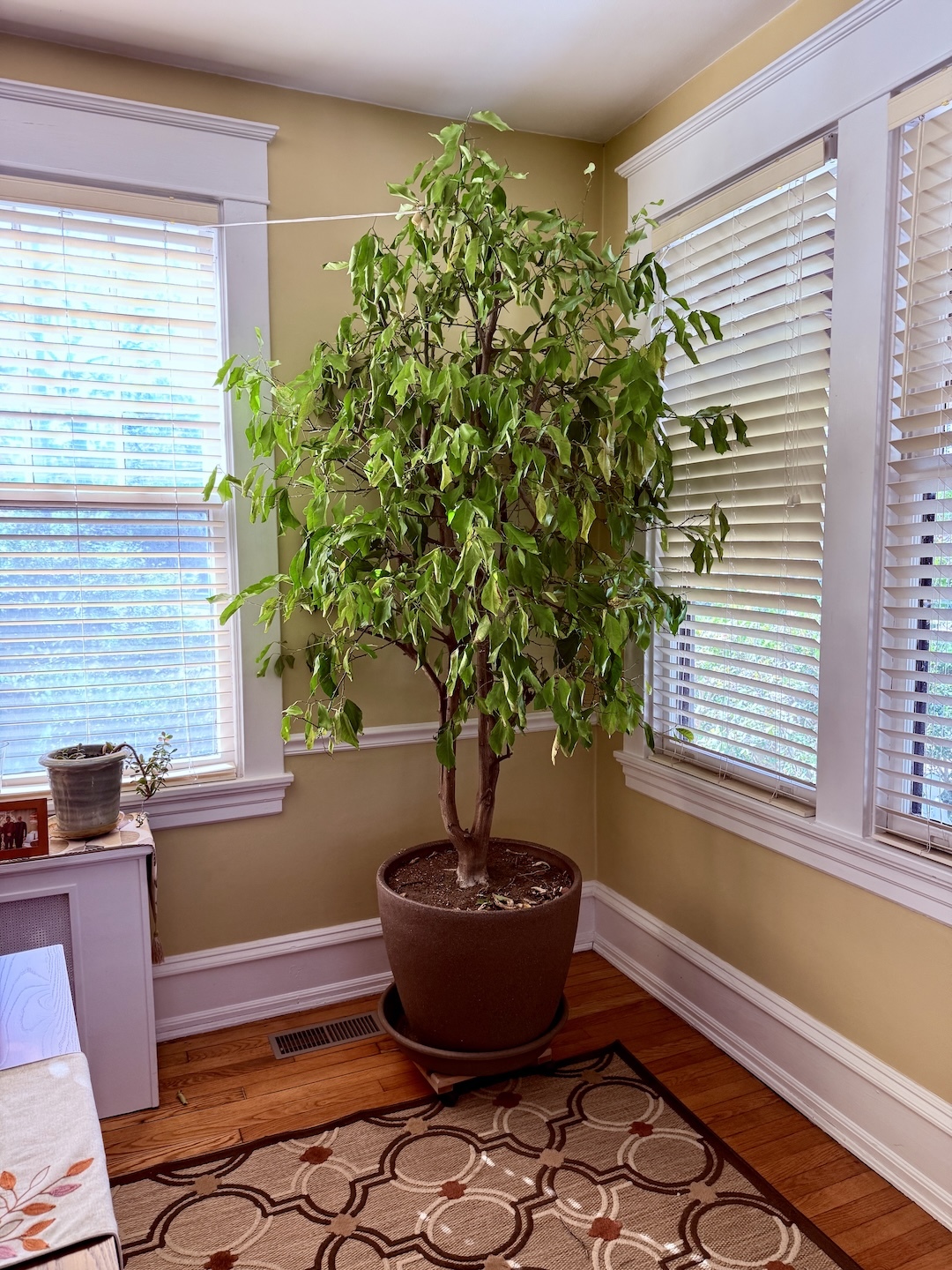
I moved the lemon tree (the aforementioned queen) back into the house for winter. When I'm working, I've taken to sometimes practicing Old English in my head, and the "queen back in the house" phrase came to me as something I knew how to say!

She looks bad because she's a hefty gal, so I have to starve her for water to lighten the weight before I can move her.
karmicdragonfly: (Default)
Well, there are a lot of things that I need right now. But top of mind this morning is that I would like to have a friend to talk grammar with! Specifically Old English grammar -- anybody who is a language nerd that likes to talk about this stuff would do!

It's pretty hard to find someone who enjoys grammar 🤓

Why do I need that? Well, when I figure out something and suddenly have a breakthrough in understanding, it would be really nice to have someone to share it with!

Example:

I puzzled over this sentence in the flashcards for the current class chapter:


I originally read Þām wīfe līcaþ sē mete. as "The woman likes (or enjoys) the food."

In that situation, I would have expected "the woman" to be in the nominative as the subject, and "the food" to be in the accusative as the direct object. But I noticed the articles and nouns are not in those cases.

Þām wīfe is Dative = "to the woman" or "for the woman" or "by the woman" -- some phrase like that.
sē mete is Nominative as a subject.

So after I puzzled a bit and looked up the endings to make sure, I realized regardless of the word order, I needed to read this as "The food is enjoyed by the woman." So the food is the subject, and the "by the woman" is the Dative form for that noun.

That makes perfect sense, and I am happy that I noticed the articles and nouns are not in the cases that support the way I originally read the sentence. I mean, even the fact that I noticed means that some of this material is sinking in!

Seriously though, this class is moving fast, and I'm having to spend way more time than I expected on it!
karmicdragonfly: (Default)
Always the language nerd, I've been interested in learning Old English for a while.

At one point, I bought a copy of Beowulf with Old English on 1 side and Modern English on the facing page. But it was exhausting looking up every grammar item and every word meaning.

So I signed up for a once a week class! This class is moving faster than I have ever known a language class to go, but it's been fun -- reading and answering questions in Old English in class, and it's fun for me to see the origins of most of the short, everyday words we use in English! The grammar is pretty similar to most Proto Indo-European languages -- nouns declined, verbs conjugated, and the like. But the point of the class is not to drill on grammar, but to read and speak and understand.

And it hasn't been too hard to adapt to reading with the unusual letters - þ and æ -- haven't seen any ð yet, so maybe they are just using þ. They both represent the "th" sound, 1 voiced and the other not. But as i understand it, there wasn't a consistent use of both of the letters in OE.

Reading g as y in some instances is not hard because the text uses diacritics to give us the info of when the sound is y. And reading the c as hard c or 'ch'/'sh' is also indicated by diacritics.

The first couple semesters are from a text written by one of the instructors, leading up to a semester where Beowulf is the text.


I always found it unusual that Portuguese (and Spanish as I understand) have 2 verbs for 'to be' -- one more permanent, and one more transient.

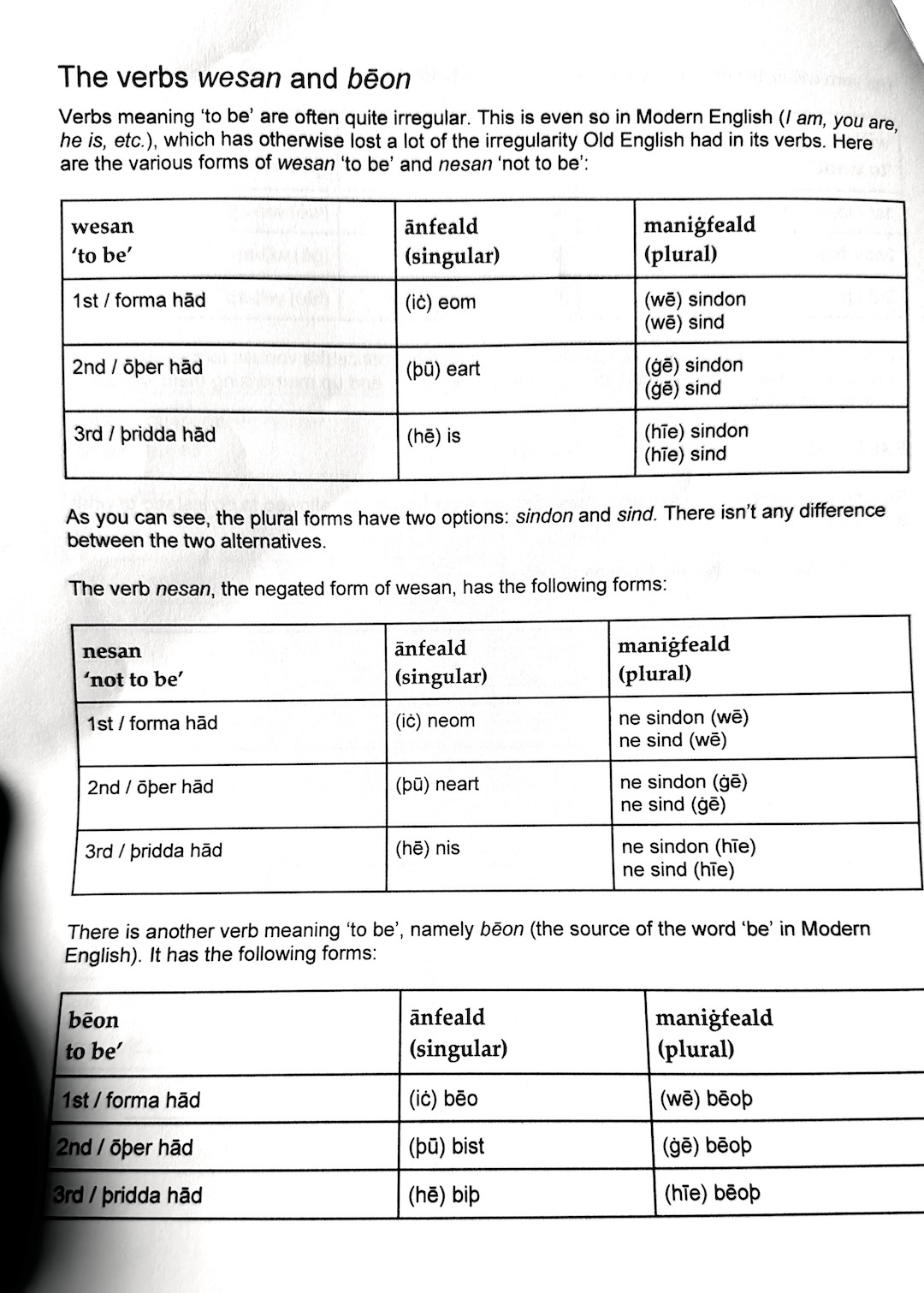
It sort of surprised me that Old English had 2 verbs also. But beon seems to be more for universal or perhaps pithy ("gnomic") truths, and wesan is used for everything else. So it's not exactly the equivalent to the 2 verbs in Portuguese.


English now or then has no dedicated, specific future tense and uses helping verbs to indicate future tense, e.g. "I will go".

It seems beon can be used to indicate future tense in Old English.
Iċ eom sē cyning = "I am the king" from wesan
Iċ bēo sē cyning = "I will be the king" ("I be the king" in the future) from beon
karmicdragonfly: (Default)
The more I think back to the group of guys I was traveling with, to the myriad of activities we did, to the friendly guides and people...the more I miss being on the trip!

Photos link

https://www.flickr.com/photos/spunkybart/albums/72177720309106210

The itinerary of the trip

  1. São Miguel island in the Azores (os Açores)
    We stayed in a hotel in the capital Ponta Delgada, and then were whisked around in vans to the viewpoints around the island. You definitely have to drive to get to the overlooks.
    Miradouro De Santa Iria (St Irene Viewpoint)

    Miradouro do Pico do Carvão (Pico do Carvão Viewpoint)

  2. Madeira island
    We stayed in the capital Funchal and were taken to the sites by van or jeep.
    Nice place to go swimming! Poças das Lesmas (Slug Puddles) on Madeira Island.

    Outdoor artwork in Funchal

  3. Porto
    This was the first stop on the mainland - I think a city I'd like to go back to and stay for a while to learn my way around. This stop included a day trip to Guimarães and Braga.
    Porto, Portugal

    Bom Jesus do Monte (Good Jesus of the Mount) in Braga

  4. Nazaré
    This was a lunch stop and some time looking around the square and viewpoint.
    Nazaré

  5. Lisbon (Lisboa)
    Lovely city, and sadly our last location before we had to leave. The stay here included a day trip to Sintra with the Pena Palace and Cascais.
    25 of April Bridge in Lisbon - similar to Golden Gate because Golden Gate engineers helped design it.

    Mosteiro dos Jerónimos (Jerónimos Monastery) / Santa Maria de Belém (St. Mary of Belém)
karmicdragonfly: (Default)
Sometimes I feel like this...constantly traveling, without roots...to live on only seeing...the absence of an end and the eagerness to get to the end...only having the dream of the passage...

These feelings are more related to my current cycle on earth...I sometimes feel there was something else I needed to accomplish.

Viajar! Perder países!
Ser outro constantemente,
Por a alma não ter raízes
De viver de ver somente!

Não pertencer nem a mim!
Ir em frente, ir a seguir
A ausência de ter um fim,
E a ânsia de o conseguir!

Viajar assim é viagem.
Mas faço-o sem ter de meu
Mais que o sonho da passagem.
O resto é só terra e céu.


On a more tangible note, I am excited about an upcoming international trip to Portugal!
karmicdragonfly: (Default)
Knowing my habit / yearning for learning other languages and specifically Old English, a friend sent me this YT cover of a Lorde song. It's pretty cool -- and I could puzzle out some of the words.
karmicdragonfly: (Default)
For practice, I use my devices in Portuguese -- phone, computers, etc. But doing so makes things difficult because, for example, I like music sung in English. So it's difficult to ask Siri to play music with a title in English.

And it makes me unreasonably happy when I tell Siri to play music and he gets it correct...in this case to "play the most recent album by Polo and Pan".


karmicdragonfly: (Default)
Good news on the job front -- I'll be starting a new gig soon! So now I'll be spending the foreseeable future replenishing my savings! Sadly, this may have been the last time I could take time off to travel -- it's just an age thing, and I suspect that the next time I take time off will be to actually retire!

As usual for one of my "Sabbaticals", I'll do a summary to compare what it was like compared to previous times.

***
Walking at the park yesterday, I saw this (presumably) newly emerged dragonfly sitting on the side of a tree. At first, I didn't even realize it was a dragonfly because the wings were folded in, and he was arching his tail sharply. As I watched, he exercised his wings, and started crawling all over the tree. Here is a pic of a brief test flight. He's out of focus, but you can see his legs dangling.
Funny - legs dangling.  This dragonfly was newly emerged -- this was a test flight after his wings had dried some.  He went right back to the tree and started crawling around it again.  (Sadly, he's outside the field of focus)

Damselfly silhouette --
Ebony Jewelwing Silhouette

***
I've been reading a book called Roman Homosexuality. It's pretty dry, but I have an interest in things Roman, in Latin, and in LGBT subjects. I like to puzzle through the Latin on my own - realizing that I have forgotten most of my declensions and conjugations, and realizing that I have to look up a lot of the words.

You can see the author's translation in the picture below:


And here is my attempt. I was generally happy that my translation approximated the author's.
In the still of night, when a fair skinned boy was warmly hidden away, lying at my bosom,
My genitals were quiet, nor did my lazy old penis raise his head in a manly way.
karmicdragonfly: (Default)
The nerdy side of me has just come all the way out during my time at home. For example, I have been reviewing Latin lessons online to see how much I remember from middle school! I mean, I have always enjoyed languages, but it even surprises me that I'm doing this!


Yesterday, I oiled the bike chain, put air in the tires, lubed the pedals, etc. It begs the question of exactly why I did that. Will I actually ride the bike soon?


karmicdragonfly: (Default)
With the pending snow and/or ice, I just put on some lentils on to slow cook. No particular recipe -- just dumped lentils, tomatoes, stock, spices and assorted other stuff into the Instapot.


Snow is preferable to ice -- ice often brings power outages. And I've put some water in pitchers in the fridge, and turned up the heat a bit just in case.


The past week was fun -- dinner or drinks with several different friends!

One night, I had dinner with my Portuguese speaking friends -- I had a good time, and for the first time, I understood most of what was said!

Of course, these friends always slow down for me, which helped. But even when they spoke slowly, I often had trouble! But this time, I understood a lot, and they even commented on that! Also, I didn't feel exhausted afterwards. In the past, I often felt exhausted because it was such hard work to follow the conversation. But I did okay this time!

profile

karmicdragonfly: (Default)
karmicdragonfly

January 2026

M T W T F S S
    12 34
567891011
12131415161718
19202122232425
262728293031 

most popular tags

...

"O seguro morreu de velho, mas o desconfiado ainda está vivo." -- "The safe one died of old age, but the suspicious one is still living."